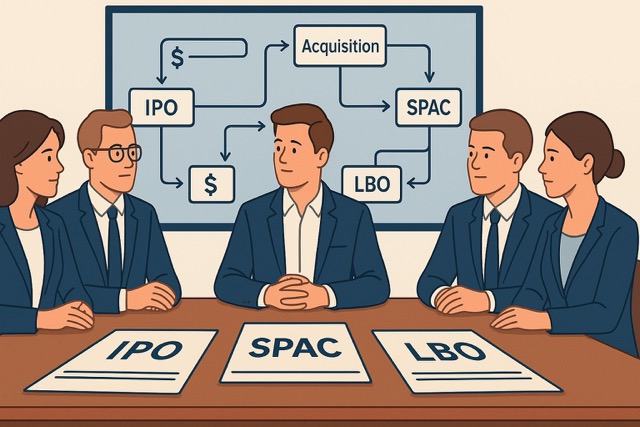
As a startup founder, the question of how you’ll eventually exit your business isn’t just about when—it’s about how. Your exit strategy will define what happens to the company you’ve built, how your investors get their returns, and what kind of role you’ll play, if any, in the next chapter. Whether you’re leaning toward an IPO, an acquisition, a SPAC deal, or something less traditional, you need a clear understanding of what each path involves. This article will walk you through the most relevant exit strategies, highlighting what to expect from each so you can match your goals with the right outcome.
IPO: Public Capital with Long-Term Commitment
An Initial Public Offering can be a strong exit strategy when your company has a clear growth story, solid financials, and ambitions that align with public market visibility. Taking your company public gives you access to capital at scale, allows early investors to cash out, and creates brand prestige that can attract new partnerships, talent, and customers. But this isn’t a quick cash grab—an IPO locks you in for a longer commitment with significant responsibilities.
Once you’re public, you’re not just running your company—you’re reporting to analysts, responding to shareholders, and living under a microscope. Your financials must be audit-ready, your governance structure must meet regulatory standards, and your team has to be prepared to communicate consistently with the public. This path can be rewarding, but it works best if you’re ready to stay in the game and lead for the next phase of growth.
Acquisition: Fast Exit with Trade-Offs
If you’re looking for a quicker and cleaner transition, a strategic acquisition might be a better fit. In this scenario, your company is purchased—often by a larger player in your industry that’s interested in your technology, customer base, or team. An acquisition can offer immediate liquidity for you and your investors, and it typically involves fewer reporting and regulatory burdens than an IPO.
The flip side is that you may have to give up control. In many acquisitions, founders stay on for a defined period to ensure a smooth transition, but they’re no longer calling the shots. Your company’s culture, brand, and product roadmap may change. If alignment with the acquirer is strong, this can feel like a win. But if your vision doesn’t match theirs, you might find yourself managing a company that no longer feels like your own.
SPAC: Quicker Public Listing with Unique Risks
Merging with a Special Purpose Acquisition Company (SPAC) gives you a shortcut to public markets without the traditional IPO process. With a SPAC, you’re acquired by a publicly traded shell company that exists solely to merge with a private business like yours. You go public faster, often with less upfront disclosure, and you can negotiate the deal terms directly with the SPAC sponsors.
This can be appealing, especially if market conditions make a traditional IPO less attractive or if you need capital quickly. But SPACs are under heavier scrutiny now, and many haven’t performed well post-merger. You still face public company obligations, and you may give up more equity or control in the deal. Make sure your sponsors bring experience and strategic value—not just capital—before you go down this road.
LBO: Private Capital with Pressure to Perform
In a Leveraged Buyout (LBO), your company is sold to a private equity firm that finances the purchase mostly through debt. This type of exit often delivers a strong payout upfront and keeps the business private, but it comes with strings attached. You’ll likely be expected to stay involved and help grow the company under tighter financial discipline.
An LBO makes sense if your company has predictable cash flow and strong operating margins. But be ready for your business to carry a high debt load, which raises risk if things don’t go according to plan. Your new backers will expect results quickly, and they’ll have clear targets for margin improvement, growth, or eventual resale. This can be a profitable transition, but only if you’re prepared to keep running hard for a few more years.
MBO: Keeping It in the Family
In a Management Buyout (MBO), your own leadership team buys out the company—often with support from a private investor or lender. This exit option lets you preserve continuity, avoid outside influence, and reward the team that helped build the company. It’s particularly appealing if you want to step back but keep the company on its current path.
The main hurdle here is financing. Your management team must secure the capital to buy you out, which often involves debt or equity partners. You may not get the same valuation you’d get from a strategic buyer or IPO, but the cultural fit and transition process are usually smoother. If you prioritize values and continuity over maximum price, an MBO can be a clean and respectful handoff.
Secondary Sale: Liquidity Without an Exit
Sometimes, you don’t want to sell the company—you just want to sell your shares. A secondary sale allows you or early investors to offload equity to a private buyer without affecting the company’s direction or ownership structure. This is especially useful if your company is still growing but you want to diversify your risk or take some money off the table.
These deals often happen quietly and require negotiation with your board or investor group. Valuation can be tricky, and not all buyers are willing to purchase minority stakes. Still, if your cap table supports it and the company is on a strong trajectory, secondary sales can offer liquidity without forcing a formal exit.
Liquidation: The Last Option
Not all exits are wins. If your company isn’t sustainable and there’s no buyer willing to acquire it, liquidation might be your only option. This means selling off assets to pay off debts, returning whatever’s left to shareholders, and formally closing the business. It’s not glamorous, but it’s sometimes necessary—and doing it cleanly is better than dragging things out.
Founders often wait too long to consider this path, hoping to turn things around or land a last-minute offer. But if you know that your market is shrinking or your cash flow is unsalvageable, acting early can preserve more value and reputation than fighting a losing battle. Know when to walk away and focus your energy on what’s next.
What Are the Best Exit Strategies for Startup Founders?
- IPO: Access to capital, long-term leadership
- Acquisition: Fast payout, reduced control
- SPAC: Quicker listing, sponsor dependence
- LBO: Private equity, performance pressure
- MBO: Internal transition, requires financing
- Secondary Sale: Liquidity without selling the company
- Liquidation: Asset recovery when no other option works
In Conclusion
Your exit strategy shapes how your company’s story ends—or continues. Whether you’re planning to go public, sell to a larger player, work with private equity, or simply cash out, the right decision depends on your goals, your company’s structure, and your appetite for risk and control. Take time to prepare, ask the right questions, and align with partners who share your vision. A well-planned exit isn’t just about valuation—it’s about legacy, direction, and setting the next chapter in motion with clarity.
Read more insights from Glen Leibowitz on Medium: Explore articles on startups, business strategy, and more.

Glen Leibowitz is a CFO and financial executive with 20+ years in capital markets and fintech. Currently CFO at Bitcoin Depot, he previously held roles at PwC and Apollo Global Management and served as CFO of Acreage Holdings. He specializes in IPO readiness, SOX compliance, and finance transformations. A CPA, he holds a B.A. in Accounting from Queens College (NY).