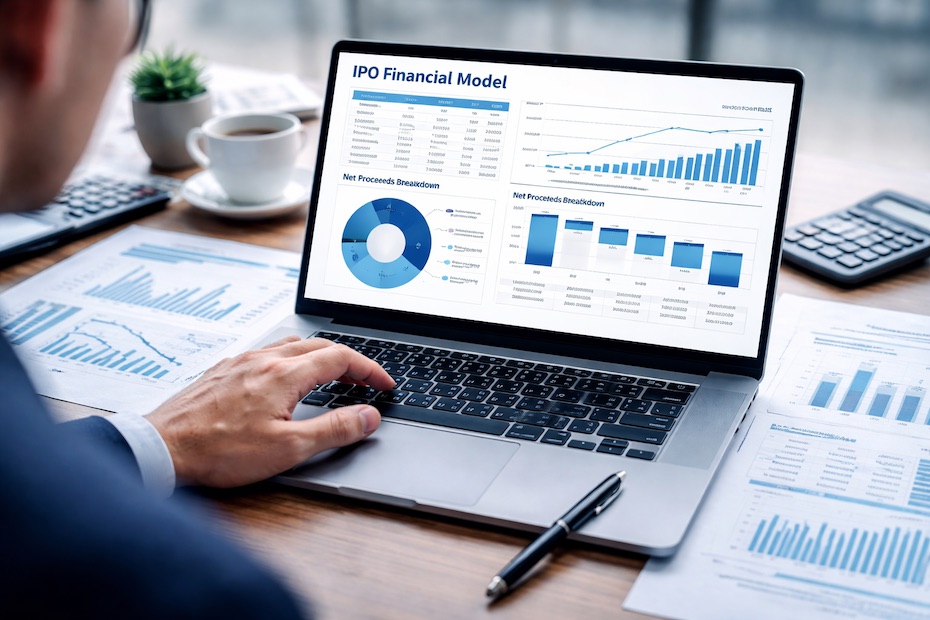
Avoiding hidden IPO costs depends on financial modeling tools that quantify fees, dilution, timing risk, and post-listing operating spend before commitments harden. When you model these variables under multiple scenarios, cost exposure becomes visible while corrective action is still possible.
Going public compresses years of financial decisions into months. This article shows how experienced executives use financial modeling tools to surface costs that routinely escape early planning. You will see which questions real founders ask, how to model answers with precision, and how to convert model outputs into pricing, timing, and structure decisions.
What hidden IPO costs do companies most often underestimate?
Hidden IPO costs usually come from fee mechanics, dilution structures, and operating expenses that scale after listing. These costs rarely appear in headline projections yet materially affect net proceeds and early-quarter performance.
Underwriting economics extend beyond stated percentages. Variable components tied to allocation mix, price bands, and stabilization activity change final cash received. When a model treats underwriting as a static line item, it masks exposure that emerges late in the process.
Operating expenses rise sharply after listing. Audit cycles tighten, reporting cadence accelerates, investor communications expand, and insurance premiums adjust upward. When these items are bundled into generic overhead, cash forecasts lose accuracy during the first two public quarters.
How do underwriting fees actually affect net IPO proceeds?
Underwriting fees reduce proceeds through both direct cash outflow and indirect dilution effects. A proper model shows these impacts together, not in isolation.
Pricing sensitivity tables should calculate net proceeds at each point of the expected price range. This includes fixed fees, variable spreads, and allocation-driven adjustments. When modeled correctly, even modest price movement reveals meaningful changes in cash raised.
Dilution modeling must accompany proceeds analysis. Primary issuance, secondary sell-downs, option exercises, and reserve pools all alter ownership. When these mechanics sit in one waterfall, leadership can see how fee negotiations influence control and earnings metrics.
Why does IPO timing risk increase total cost exposure?
Timing risk converts uncertainty into measurable expense. Delays introduce carrying costs, financing gaps, and repricing effects that compound quickly.
A calendar-linked cash model ties filing milestones to burn rate, working capital, and interim financing needs. When pricing shifts by weeks, interest expense, advisory overages, and vendor extensions accumulate. Without date-driven modeling, these costs surface only after commitments lock.
Experienced teams build downside timing cases. A two-week or six-week delay scenario quantifies incremental cost and liquidity impact. This clarity supports informed decisions on pacing, resizing, or postponement.
Which financial modeling tools reveal hidden IPO costs most effectively?
Integrated three-statement models with scenario control expose cost drivers fastest. These tools connect income, balance sheet, and cash flow effects under changing assumptions.
Spreadsheet-based models remain standard, enhanced with version control and audit discipline. Advanced teams add scenario managers that toggle pricing bands, allocations, and timing while preserving model integrity.
Visualization tools accelerate decision-making. Dashboards that roll net proceeds, dilution, and runway into one view allow leadership to evaluate trade-offs in real time rather than through static memos.
How should post-IPO operating and reporting costs be modeled?
Post-IPO costs require a dedicated ramp that begins at listing and stabilizes over quarters. Folding these expenses into general overhead obscures their near-term cash impact.
Build separate schedules for reporting cadence, controls testing, investor relations, insurance, and listing-related systems. Phase these costs quarterly to reflect onboarding spikes followed by steady-state levels.
Validate assumptions against peer disclosures and advisor benchmarks. When the model shows first-year operating impact clearly, budget approvals move faster and early earnings volatility declines.
How does scenario analysis prevent last-minute IPO cost surprises?
Scenario analysis works by forcing trade-offs into view before negotiations close. The objective is preparation, not prediction.
Construct base, downside, and upside cases that differ on price, allocation, and timing. Each scenario should output net proceeds, dilution, earnings impact, and cash runway using identical structure.
When bankers propose late adjustments, leadership can quantify the effect immediately. Speed turns analysis into leverage and limits reactive concessions.
What questions do investors expect your IPO model to answer?
Investors expect clarity on cash durability, dilution tolerance, and execution discipline. Your model must answer these without manual explanation.
They examine sensitivity to low-range pricing and early-quarter burn. They test assumptions behind operating cost ramps and working capital shifts. Models that answer these questions cleanly build confidence.
Credibility reduces friction. When assumptions withstand scrutiny, negotiations focus on structure rather than trust gaps.
How financial modeling tools support stronger IPO negotiations
Financial modeling tools do more than forecast; they anchor negotiation strategy. When cost exposure is quantified, discussions shift from opinion to evidence.
Leadership teams use model outputs to define walk-away thresholds on fees, allocation, and timing. These thresholds prevent incremental concessions that erode value.
Well-built models also align internal stakeholders. Boards, advisors, and executives operate from a shared financial truth, reducing last-minute conflict.
Avoiding Hidden IPO Costs with Financial Modeling
- Model fees, dilution, timing, and operating costs together
- Run pricing and delay scenarios
- Tie assumptions directly to cash flow and runway
Turn Your IPO Model into a Cost-Control System
Financial modeling tools protect value when they expose costs early and quantify trade-offs clearly. You control IPO outcomes by modeling fees and dilution together, linking timing to cash, and isolating post-listing expenses. Scenario discipline transforms uncertainty into options you can act on with confidence. When your model answers investor questions instantly, negotiation posture improves and execution tightens. That is how experienced operators keep IPO costs visible and manageable before they harden into irreversible outcomes.

Glen Leibowitz is a CFO and financial executive with 20+ years in capital markets and fintech. Currently CFO at Bitcoin Depot, he previously held roles at PwC and Apollo Global Management and served as CFO of Acreage Holdings. He specializes in IPO readiness, SOX compliance, and finance transformations. A CPA, he holds a B.A. in Accounting from Queens College (NY).